Machine Learning
A new dimension to access content of this website
Personalized handwriting decoding from wrist EMG
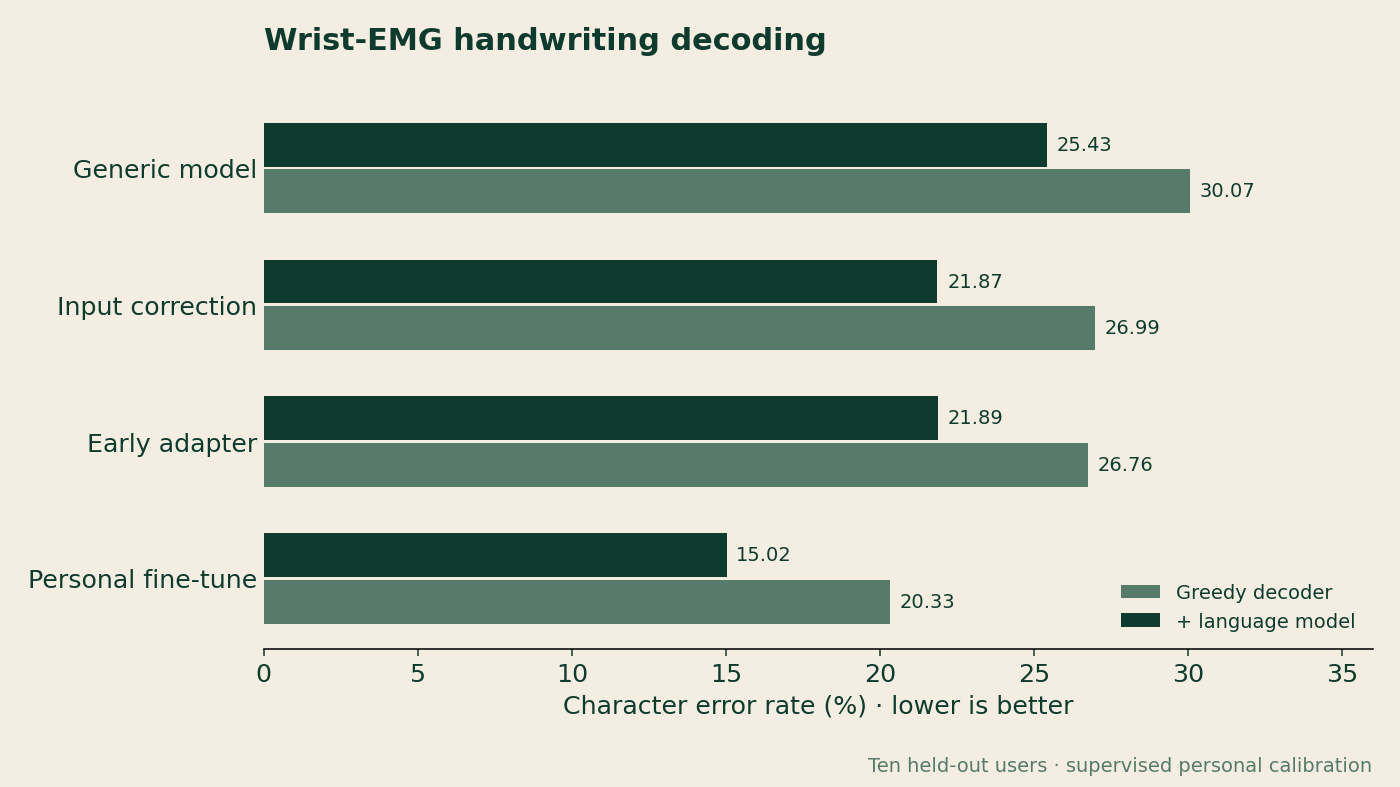
Reproducing Meta’s wrist-EMG handwriting decoder and reducing character error from 30.07% to 15.02% on ten held-out users through personalization and language-model decoding.
LibriBrain 2026: decoding speech from MEG
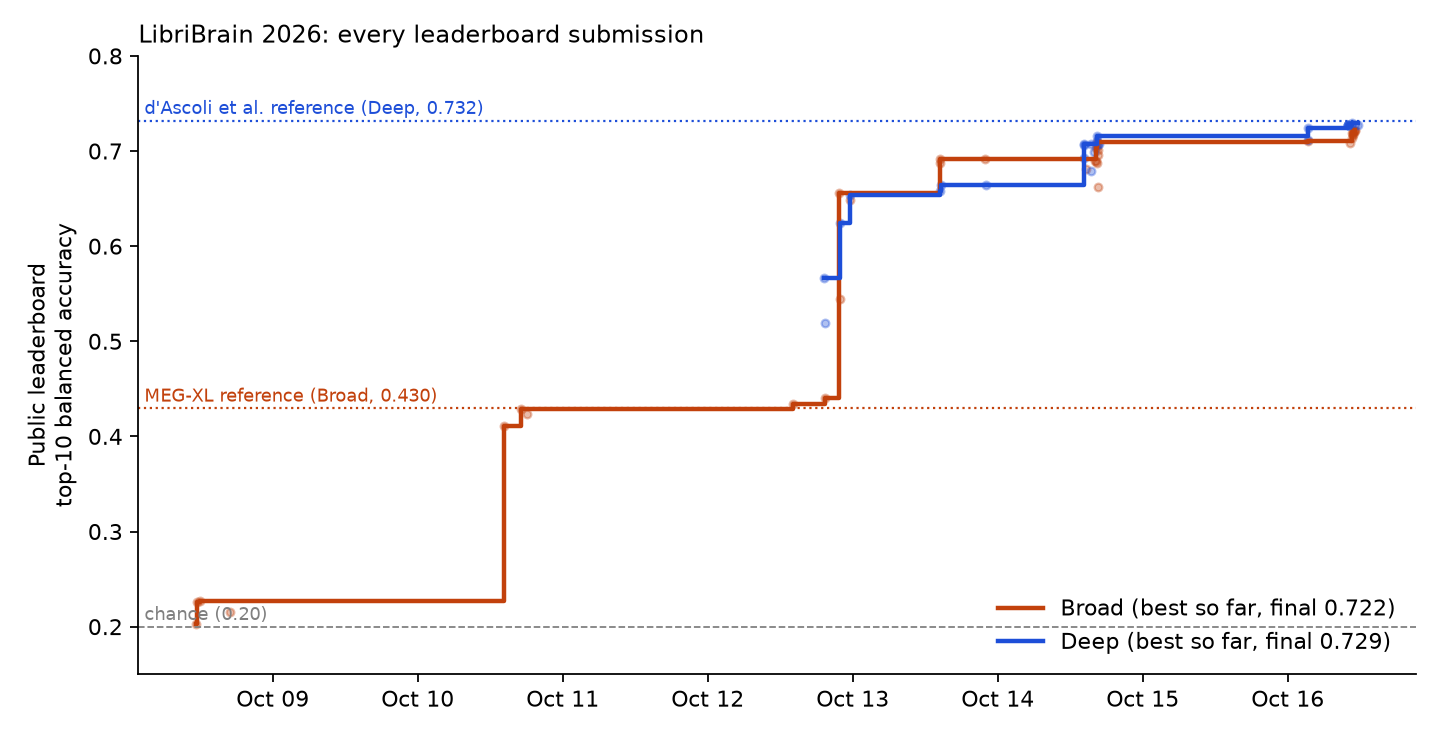
MEG word decoding for LibriBrain 2026: public scores of 0.722 on Broad and 0.729 on Deep; final private ranks 17th of 53 (Broad) and 26th of 91 (Deep). Includes transfer learning, test-time adaptation, and an evaluation of timing-only baselines.
Undergraduate Researcher
Neither a prover nor a guesser
What two ARC Prize 2026 tracks taught me about generalization: a solver that only proves cannot cover the tasks, a solver that only guesses cannot know when it is right, and the architecture has to carry both.
Eighth in public, seventeenth in private
What the LibriBrain private leaderboard did to my final standing, which interventions survived the second split and which reversed, and what that implies for choosing final submissions.
What timing reveals about MEG decoding benchmarks
Technical notes from LibriBrain 2026: contextual training targets, cross-subject transfer, test-time adaptation, and a timing-only baseline that changes how decoder scores should be interpreted.